

We Know Why We’re Here
For Leetha Filderman at PopTech, success and purpose are intertwined.

I’m Chris, writer here at The So What and head of creative and story at Artemis Ward. Every month or so I sit down with somebody who has a finger on the pulse of culture, creativity, and brand — and together, in five questions + five answers, we try to understand what it all means. Read on for “the so what”: why gatherings aren’t the same thing as communities and what brands can learn about the difference.
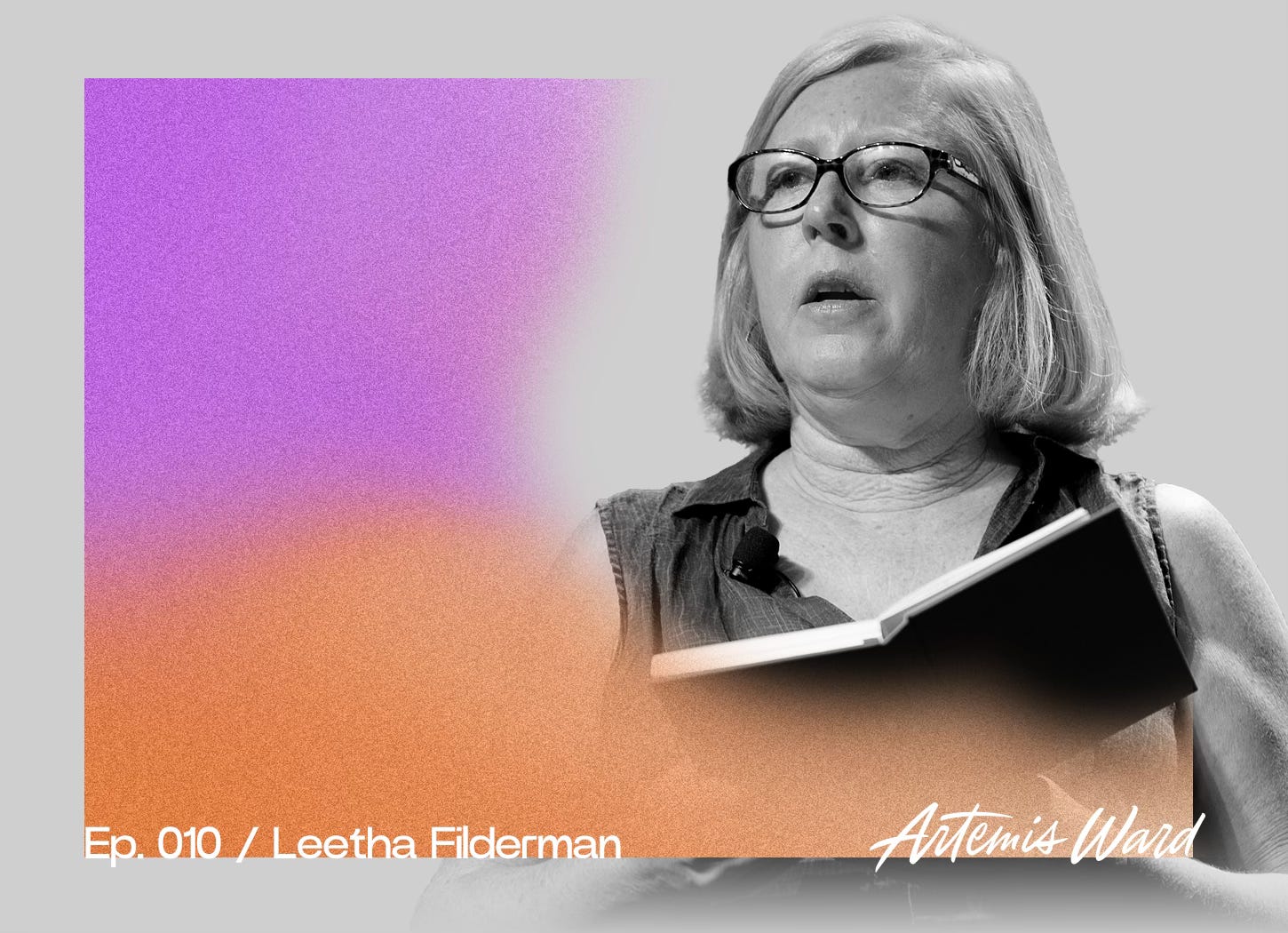
While Leetha Filderman’s multi-dimensional career has spanned public health, strategic planning, fundraising, and more, there’s a common thread that holds everything together: an obsession with the power of collaboration to bring about social change. So, it’s little wonder that she found her way to PopTech, a global community that fosters conversations and collaborations at the intersection of technology, science, and creative expression in order to accelerate positive change in the world around us. At the center of this community is an annual forum that Wired Magazine has called “the TED for real thinkers.”
PopTech was started in 1996 (ten years before Leetha arrived on the scene) by former Apple CEO John Sculley and Ethernet inventor Robert Metcalfe. Back then, it was hosted in the small, coastal town of Camden, Maine, and was called the Camden Technology Conference — an annual gathering focused squarely on the social impacts of information technology and other emerging innovations. By the time Leetha joined the organization in 2006, initially to co-design the impact side of the org, the name had changed to Pop!Tech (the exclamation point has since been retired) and PopTech had begun its evolution from tech to broader topics around science, creativity, and culture. Just look at the hundreds of speakers and performers who’ve participated in PopTech over the years, including Adam Gopnik, Malcolm Gladwell, John Fetterman, Esther Perel, Marcia McNutt, John Legend, Jill Sobule, Reggie Watts, and, as Leetha will proudly remind you, hundreds of speakers who are not yet household names but are leading pioneers in their fields.
As Leetha steers PopTech into its 30th year, she’s ready to build on this legacy while keeping her eyes squarely on the future. We caught up to get her take on driving cultural conversation, cultivating loyal communities, never losing sight of the reasons you’re bringing people together in the first place, and curating the 30th annual PopTech forum, which is coming this October to Washington, D.C.
I want to start with a big congratulations. Poptech is celebrating its 30th year — such a big milestone. In what ways has PopTech morphed since its founding to stay relevant and remain on the cutting edge of cultural conversation?
We have always worked in an ultra-competitive space. We’re compared to TED, Aspen Ideas, SXSW, and Skoll World Forum. We applaud all these entities and have lots of colleagues across all of them. But to make sure PopTech’s best is yet to come, we remain focused on delivering what’s always been distinctive to what we do, constantly innovating, constantly looking at what’s next. We’re not really into nostalgia and looking to the past. The past is our springboard into the future.
Our first decade was about exploring the impact of rapidly emerging technology on society. The second decade coincided with the dawn of the “thought leadership forum” — when TED transitioned from an intimate Monterey gathering to something much bigger, and a real market for what I would call “knowledge media” emerged. At this time, PopTech became highly regarded for our curatorial expertise by identifying and spotlighting relatively unknown thought leaders in science, tech and the creative arts — something that’s been a distinctive hallmark of PopTech ever since. The next chapter was really about acting on the ideas and inspiration coming from the stage and connecting people — people in the audience, people on the stage — by creating a structure to act on what they heard. So, while our yearly forum is our public-facing, most known entity, we’ve grown an entire portfolio of high-impact projects. To support that work, we designed two fellows programs that have mentored and accelerated the work of emerging innovators, scientists, and creative individuals, many of whom have collaborated with us on projects. As we look toward our fourth decade, we are amplifying our commitment to stewardship and community-building.
In her book The Art of Gathering, Priya Parker talks about this centuries-old Japanese practice called ichi-go ichi-e, which roughly means “one meeting, one moment in your life that will never happen again.” Based on what you’ve just described, I think this really captures the spirit of PopTech — the way that you embrace the uniqueness of the experience each time you bring people together, especially your annual forums. How do you make each gathering a one-of-a-kind experience? What are the elements that set you apart from those other competitors you talked about earlier?
For many years now, we’ve had a theme for each year’s forum. It’s not a literal thing; we don’t say, we are literally going to discuss XYZ. It’s primarily a way to define the moment we’re in as a society. And I think that brings vibrancy, energy, and relevancy to our work.
Another key ingredient is that we always try to bring in new voices. A lot of the people on stage are experts within their respective fields, but they are not well-known to the general population. If you ask people who come to PopTech what our secret sauce is, they say: I go to PopTech to hear presenters talk about what’s next, and then literally a year or two later, I see them on the TED stage. So, for us, I think it’s about always bringing in new voices both on the stage and in the audience.
And finally, we are committed to diversity, intimacy, and a spirit of generosity. This spirit of generosity is often not recognized from the outside, but once you’re part of PopTech, you see that it is the foundational element of the organization. People are ready to give, support, share, learn, push back — whatever’s needed.
“In so many ways, PopTech is the quintessential American brand. We convene, we ideate, we debate, we celebrate great ideas — all of which shape the American Dream.”
I love that. I think that spirit of generosity is also what makes you a real community and not just a forum or an event series. So, it makes sense that, these days, PopTech encompasses an entire network of people that are active all year long, in different places. What’s your approach to community building and how do you make sure that the waters remain fresh?
We, as an organization, have always been driven toward the common goal of meaningful human connection. What does that mean? And how do you pull that off? These are the questions we constantly ask ourselves. Because some connections happen naturally, but a lot of them have to be thoughtfully engineered, for lack of a better word.
In the case of our annual forum, that means learning together, conversing together, disagreeing together, debating. When you have that openness — that acceptance that it’s okay if you don’t agree with me, but we’re going to find a civil way, not a polarizing way, to have that exchange and recognize our differences — then community starts to happen. Coming to a shared respect for a cultural moment, or a political movement, or a scientific discovery — that takes effort. And if you invest the time to have a genuine back-and-forth conversation and an openness to hearing both sides of the coin, I think you’re tapping into something that’s really defining for us at PopTech.
This year not only marks PopTech’s 30th birthday, but also America’s 250th birthday. This year’s conference theme is Civil, which I’m guessing is no accident, given where we are as a country heading into America 250. How do you hope that PopTech can participate in our current national conversation?
You know, we’re not a political organization — that’s not our goal, not our mission, it’s nowhere in our bylaws. If anything, we’re agnostic in terms of political sides, and I think it’s been really important for us to stick to that. Do politics surface in these conversations? Yes, of course they do. We’re a global convener and we have people on our stage and in our community who come with diverse ideologies. To be honest, we didn’t give a lot of thought to the 250th anniversary of our country because we aren’t a political or a national brand.
And yet, in so many ways, PopTech is the quintessential American brand, right? We convene, we ideate, we debate, we celebrate great ideas — all of which shape the American Dream.
So, the theme for this year — civil — isn’t political commentary; it’s a reflection of where we are as a country and a world right now. And if you throw that word out to any group of people, everybody’s going to have a different association with it. Civil liberties. Civil servants. Civil rights. Civil disobedience. Civil society. It’s a complex word that’s so distinct for this moment in time. We’re in a moment that’s broadly defined by fragmentation, pessimism, information overload — things that are recurring stressors for people. Yet in the midst of this, we’re committed to finding pathways to meeting, learning, thinking, and building together.
“The ability to bring people together intentionally and in a meaningful, goal-driven manner is critical.”
You clearly think a lot about what it means to bring people together in purposeful ways. To broaden out a little beyond PopTech, we’re seeing an ever-growing appetite among brands to curate and host valuable in-person experiences that let them really cultivate communities and connect with their audiences in ways that are memorable and — to use your word — meaningful. Do you have any advice for brand leaders who are leaning into strategies that include substantive in-real-life experiences for their audiences?
We will see more changes in the next three years than we will have seen in the last 30. In a moment of AI prowess — technology that could potentially outpace us, depending on who you read at any given moment — the ability to bring people together intentionally and in a meaningful, goal-driven manner is critical. It’s probably more important now than it was ten years ago, when it was much easier to come together — when you actually came together every day at the office, and as a family, a time when we were not as far-flung. I think being together in person — as long as there’s a meaningful goal that you’re trying to accomplish — is more important now than ever.
So, for me and for PopTech, our priority is bringing people of diverse backgrounds together to provide an opportunity for shared learning, ideation, and an expanded sense of self. To come together in meaningful ways. And I think if brands can do that — that is, make people feel like they’re part of something meaningful — then they’ll be on the right track, too.
📲 Keep up with Leetha on LinkedIn, and follow PopTech on Instagram for all the latest — registration for this year’s PopTech is open now.
✉️ And, if you haven’t yet subscribed, click the button below so you don’t miss the next one.
Read more from Chris:


And don’t miss last week’s post from Colin:
