


Hi everyone, welcome back! In case you’re new here, I’m Olivia, a senior copywriter at Artemis Ward and your guide for this monthly column, where we dive into the deeper shifts behind viral moments and what they mean for us. Let’s take the plunge.
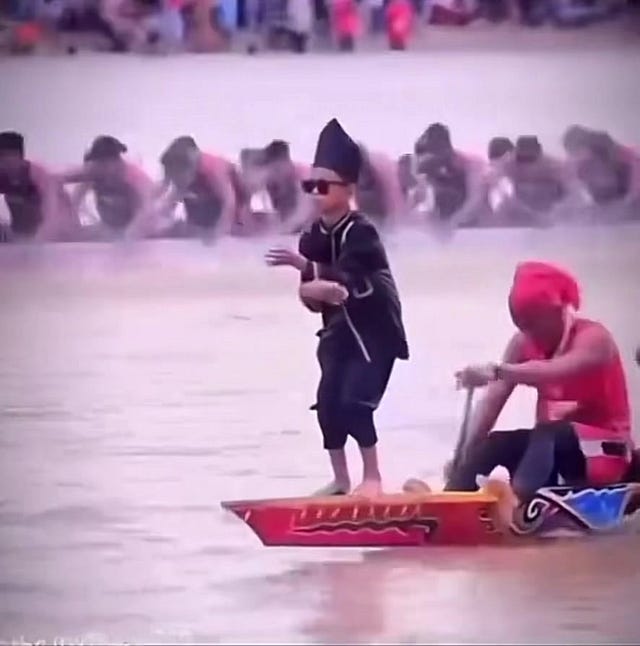
If you’ve been anywhere on the internet over the last few weeks, you’ve likely heard of “aura farming boat kid,” a.k.a. Rayyan Arkan Dikha (fondly known as Dika), an eleven-year-old boy from Indonesia who went viral for dancing on the front of a boat. Maybe you know him because of his recent mention in the New York Times, or maybe you found him from the countless people (celebrities included) who have tried create their own versions of his iconic video.
 Tiktok failed to load.
Enable 3rd party cookies or use another browser
Straight-faced, dripped out in shades, and somehow perfectly balanced, Dika dances on the bow of a long wooden canoe while his teammates row furiously behind him. It’s the kind of video that, when paired with just the right audio, seems engineered for virality. But what makes this video feel longer-lasting than a typical meme is the phrase that keeps showing up along with it in comments, captions, and stitches: aura farming.
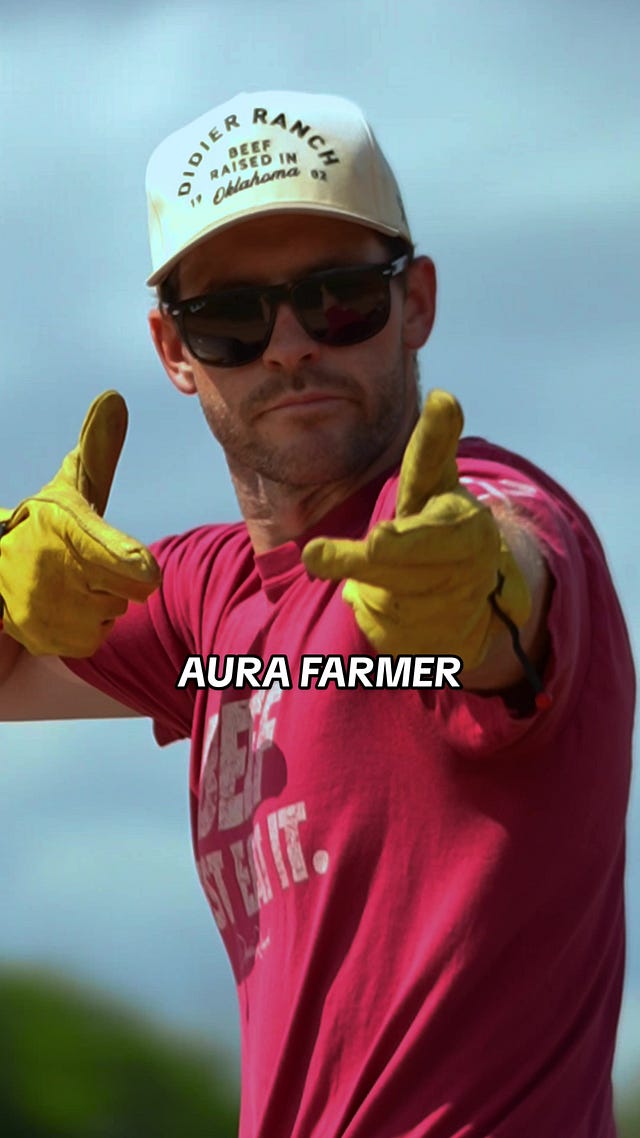
And if you’re wondering what aura farming is, first, let me show you what it’s not.
 Tiktok failed to load.
Enable 3rd party cookies or use another browser
All jokes aside, if you’ve never heard of aura farming, you’re not alone — and if you have, there’s a good chance the first time it came across your feed, it was being used as a jab. Aura farming, according to Gen Alpha (and the gaming culture they’re steeped in), is when someone does something to show off their aura, a kind of ambient coolness or mystique — a vibe you’re not supposed to chase outright because wanting it too much makes it disappear.
The phrase borrows directly from gaming, where farming refers to the grind of repeating the same action over and over to collect something valuable, like experience points, currency, or rare gear. In the case of aura farming, though, what you’re trying to accumulate is attention or relevance (you may remember the aura points trend from late last year, where actions were given negative or positive “aura points” based on their perceived level of coolness).
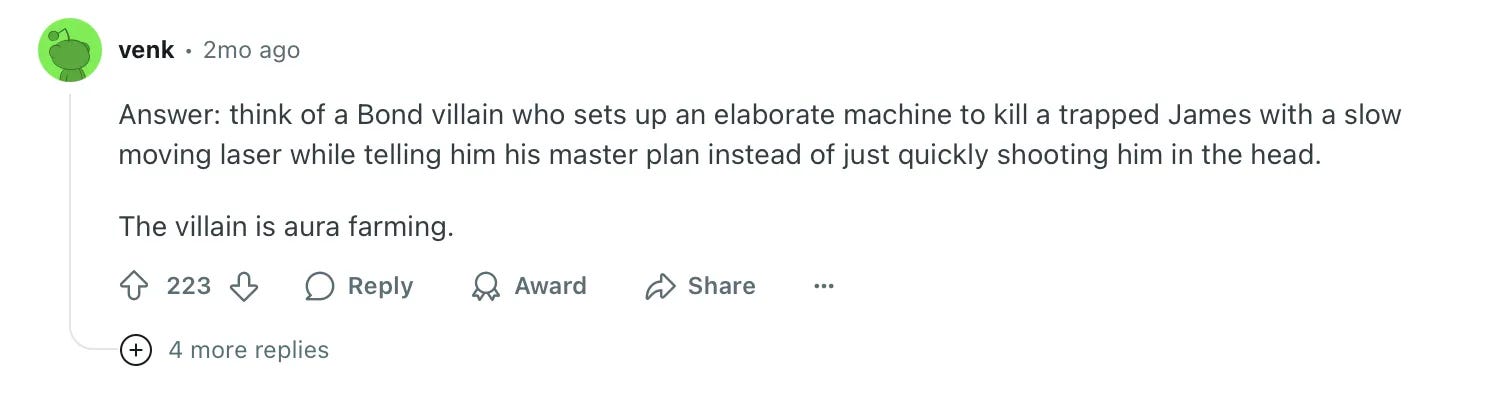
To call someone an aura farmer is usually to imply they’re trying too hard. And when it comes to coolness, visible effort is often the fastest route to cringe. This Reddit thread puts it nicely (well, sort of):
But here’s what I love about the phrase (and why I get excited when new words enter the conversation). Aura farming brings two wildly different ideas into collision, telling us a lot about what Gen Alpha values and how they perceive “cool.” Aura, coming from the Greek word for breeze or breath, is all about lightness — something you feel, but can’t pin down. Farming, by contrast, is anything but intangible. It’s repetitive, methodical, and work-intensive. And when you put those ideas side by side, something interesting happens: the idea of coolness as a grind.
And that tension is exactly what makes Dika’s boat dance so cool (forgive the pun).
In theory, his precise moves and repeated poses should read as try-hard aura farming. But in watching the video, it doesn’t feel fake or performative. It feels like a kid fully present in a moment with his friends. And, his conversation with BBC Indonesia confirms that instinct:
"I came up with the dance myself… It was just spontaneous."
But when you watch the video closely, you can tell at least some effort went into it. You don't just casually dance on the bow of a narrow wooden canoe while it cuts through water — that's a skill that requires practice, muscle memory, and a fall or two. But Dika didn’t practice a viral moment. He practiced a difficult skill and got really good at it, allowing him to be spontaneous enough to come up with a dance while doing it.
So yes, people are calling the video aura farming. But they’re also using the term with a sense of admiration, suggesting that the meaning of the phrase is starting to shift. In Dika’s case, at least, it’s becoming a shorthand for the kind of cool that doesn’t need to announce itself because it’s backed by evidence.
The So What
This distinction between intended coolness and emergent coolness reveals something important about how Gen Alpha processes authenticity. Gen Alpha has grown up in a world where everyone is performing all the time, so they've developed a sophisticated radar for spotting the difference between someone doing something “for love of the game” and someone doing something because they think it will go viral. In other words, they can spot the difference between someone who practiced juggling for years and then happened to go viral versus someone who learned to juggle specifically to go viral.
This is why most attempts to replicate Dika's video are quick hits that will be forgotten in a week’s (if not an hour’s) time. They're copying the performance, not the effort that allowed a viral surprise to come out of it.
And that’s the real distinction aura farming is starting to draw: between effort in service of a skill and effort in service of being seen. In this way, this newly evolved definition of aura farming is less an insult and more the ultimate litmus test for decoding intention. And the people who use it are telling us something older generations have struggled to articulate: coolness doesn’t have to be entirely unplanned — but it does have to show you’ve put in the reps.
✉️ If you haven’t yet subscribed, click the link below so you don’t miss the next one: another round of Link Lariat with Ryan Weicht.
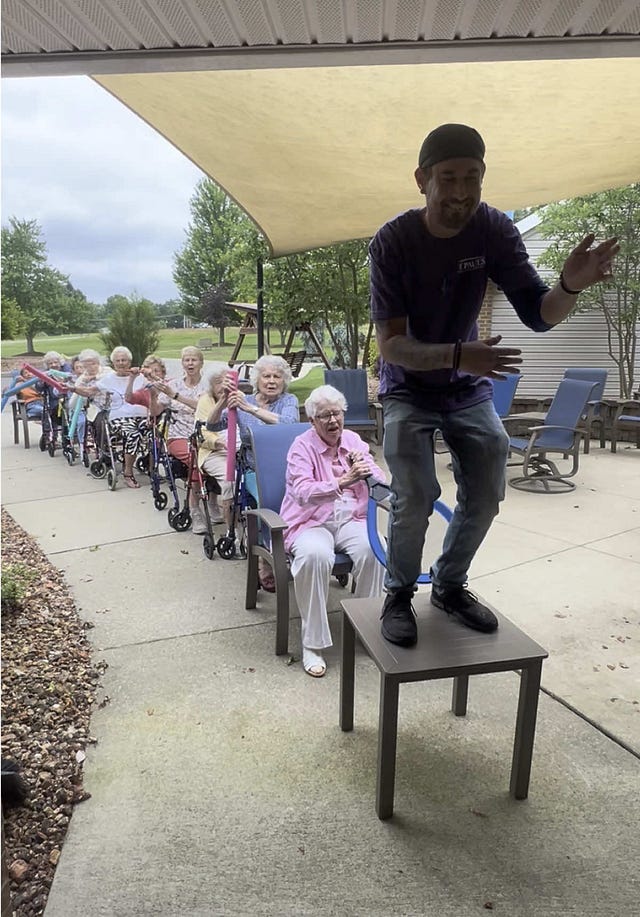
🚜 And, if you made it this far, here’s another aura farming video for the road.
 Tiktok failed to load.
Enable 3rd party cookies or use another browser